Qiongtai Temple
Qiongtai Temple China
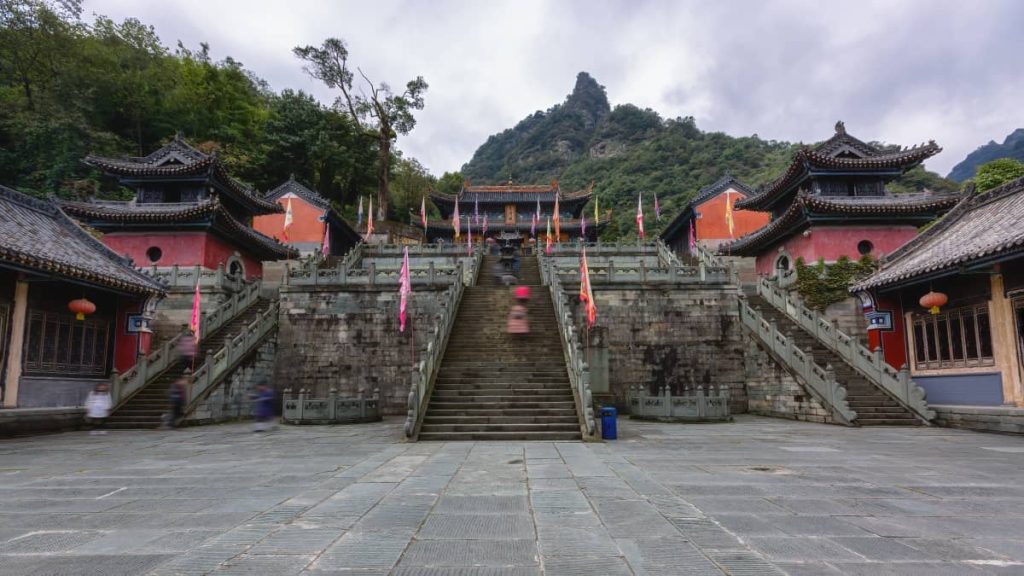
Qiongtai Temple China, is located about 10 kilometers southeast of Tianzhu Peak on Wudang Mountain, with a vertical elevation difference of 1,350 meters.
The site is divided into upper, middle, and lower temples. In the Yuan Dynasty, it was originally called Qiongtai Palace.
To understand the rich Qiongtai Palace history, one must look to the Ming and Qing Dynasties, when the site was expanded into 24 Taoist courtyards.
This expansion formed a massive architectural complex connected by pavilions and bridges, making it one of the largest among Wudang Mountain’s 36 temples.
The remaining structures standing today include reconstructed temple houses from the Qing Dynasty and a rare stone hall preserved from the Yuan Dynasty.
Today, it serves as the essential starting point of the Wudang Mountain passenger cableway and is an important tourist hub.
According to historical records, the Great Emperor Zhenwu was conferred the title of Emperor of the North Pole and Xuan Tian by the Jade Emperor here, which is why it is highly revered as a sacred Taoist site.,
The Three Ancient Temples
The three architectural sections of the Qiongtai Palace complex are also known as the “White Jade Tortoise Platform,” “Purple Yue Qiongtai,” and “Jade Le Xiao Tai,” respectively.
The Middle Temple: Preserves a bluestone hall from the Yuan Dynasty, housing a stone statue of Xuanwu, with a floor area of 18 square meters. Currently, a magnificent statue of the Great Emperor Zhenwu stands on the platform directly in front of the Ancestral Hall.
The Upper Temple: Retains authentic stone inscriptions from the Ming Dynasty alongside the ancient ruins of a stone statue of Xuanwu.
The Lower Temple: Preserves the traditional main hall and various auxiliary rooms dating back to the Qing Dynasty.
In 1856 (the 6th year of the Xianfeng reign), the temple buildings were unfortunately destroyed by war, though partial reconstruction was later carried out during the historic Guangxu reign.
Reflecting the syncretic nature of Wudang culture, the side halls on both sides enshrine highly revered Chinese folk religion gods, including Guanyin, Bixia Yuanjun, and the Three Stars of Fu, Lu, and Shou, respectively. Structurally, the walls of the Yuan Dynasty stone hall are nearly 1 meter thick, completely retaining the magnificent, enduring characteristics of raw bluestone.