Wudang Mountain Introduction
Wudang Mountain China Introduction
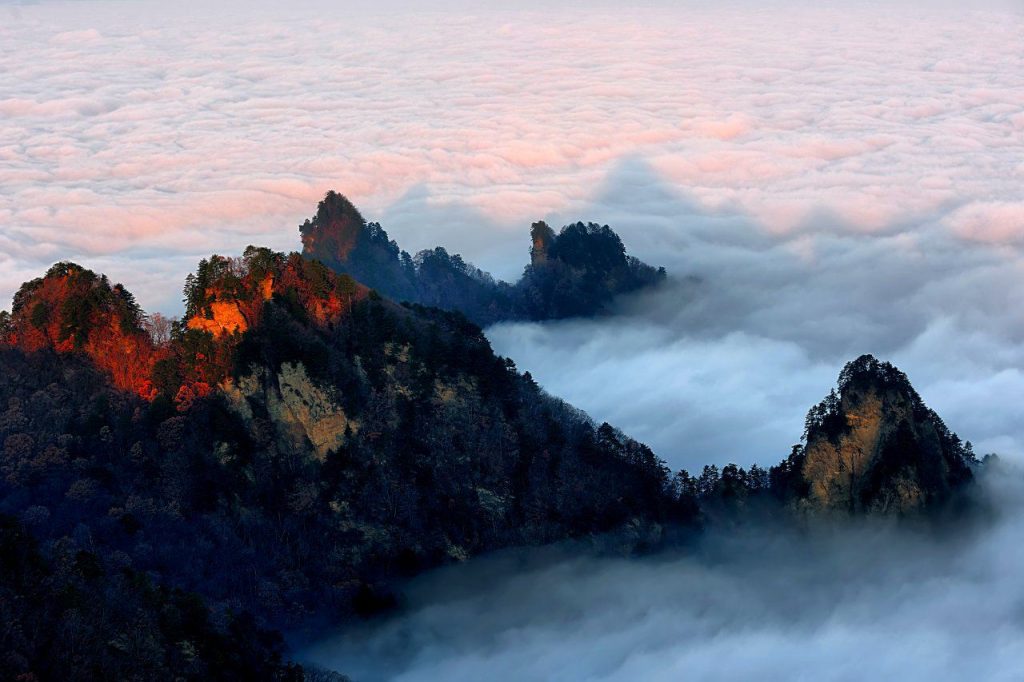
Wudang Mountain China, a sacred Taoist site, is also known as Taihe Mountain, Xieluo Mountain, Canshang Mountain, and Xianshi Mountain. In ancient times, it was honored with titles such as “Taiyue,” “Xuanyue,” and “Dayue.” It is located in Danjiangkou City, Shiyan City, in the northwestern part of Hubei Province. This holy taoist mountain borders Xiangyang City to the east, leans against Shiyan City to the west, overlooks Shennongjia to the south, and faces the Danjiangkou Reservoir to the north.
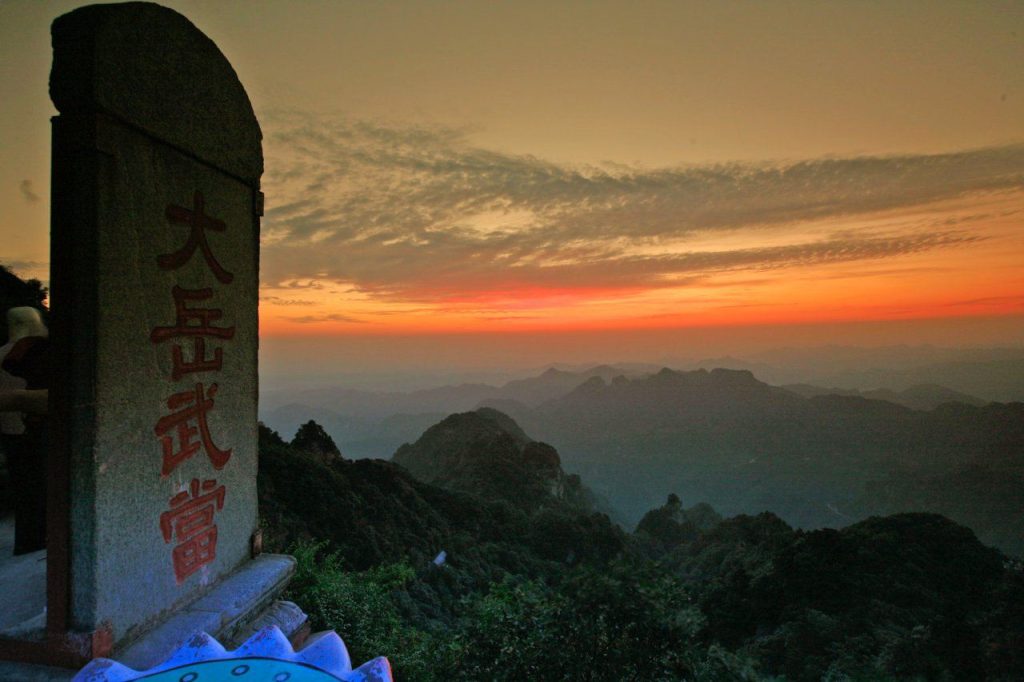
During the Ming Dynasty, Wudang Mountain was conferred the titles “Dayue” and “Zhishi Xuanyue” by the emperor and was revered as the “Imperial Family Temple.” It is world-famous for its status as the “Crown of the Five Sacred Mountains,” with “all four great mountains bowing in reverence and celestial peaks from five directions paying homage.”
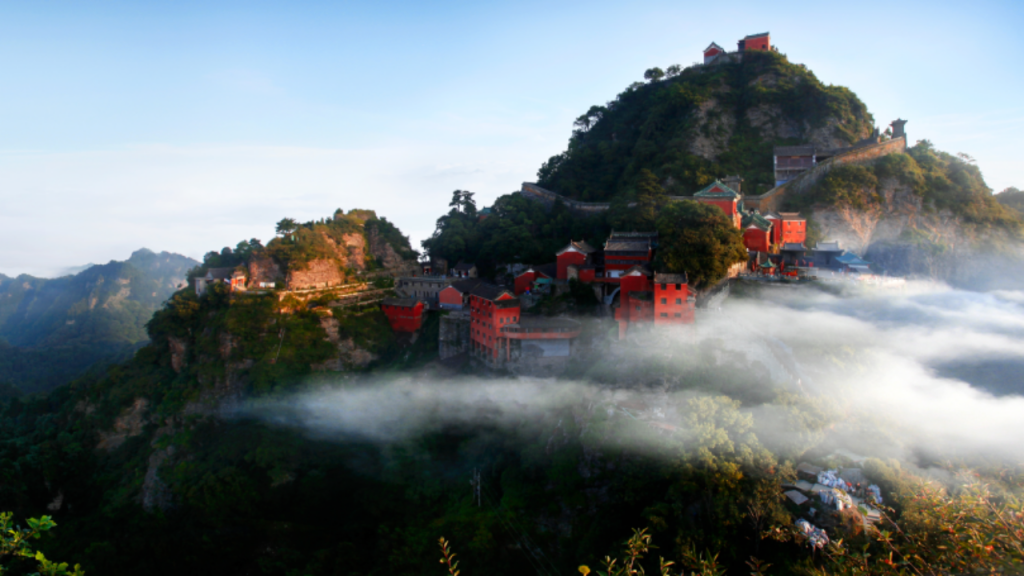
As a renowned peak deeply tied to wudang mountain taoism and the birthplace of Wudang Kungfu, it is hailed as “an unparalleled scenic wonder since ancient times and the foremost celestial mountain under heaven.” Wudang Kungfu is an important school of Chinese martial arts. In the late Yuan and early Ming Dynasties, Taoist priest Zhang Sanfeng synthesized its essence and founded the Wudang Sect. As of 2013, Wudang Mountain boasted 53 ancient architectural structures with a total floor area of 27,000 square meters, 9 architectural ruins covering over 200,000 square meters, and 5,035 cultural relics preserved throughout the mountain.
In December 1994, the Ancient Building Complex of Wudang Mountain was officially inscribed on the UNESCO World Heritage List. In 2006, it was designated as a Major Historical and Cultural Site Protected at the National Level in its entirety. In 2007, Wudang Mountain was selected as one of the “Top Ten Chinese Scenic Spots Most Loved by Europeans.” From 2010 to 2013, it was successively rated as a National AAAAA Tourist Attraction, a National Forest Park, and one of the “Top Ten Summer Resort Mountains in China.”
Major Attractions
Wudang Mountain features numerous scenic wonders, including 72 peaks, 36 cliffs, 24 gorges, 11 caves, 3 pools, 9 springs, 10 ponds, 9 wells, 10 rock formations, and 9 terraces. Centered around Tianzhu Peak, the scenic area boasts perilous paths like the Upper and Lower Eighteen Bends, as well as iconic landscapes such as “Seventy-Two Peaks Bowing to the Main Summit.” The most famous palaces and temples gracing wudang mountain china include:
Golden Summit and Taihe Palace
Nanyan Palace
Zixiao Palace
Fuzhen Temple, Qiongtai Temple, and Wulong Palace
Wudang Taoism
The roots of Wudang Mountain Taoism stretch back millennia. From the Spring and Autumn Period to the late Han Dynasty, many high-ranking officials and nobles came to this holy Taoist mountain to cultivate themselves, including Yin Xi, a senior official of the Zhou Dynasty, and renowned alchemists Ma Mingsheng and Yin Changsheng. From the late Han Dynasty to the Northern and Southern Dynasties, amid social turmoil, hundreds of scholar-officials gathered here to practice bigu (abstinence from grains). During this period, scriptures related to zhenwu (the True Warrior) also emerged.
In the Sui and Tang Dynasties, the Li Tang royal family claimed to be descendants of Laozi, vigorously elevating Taoism. During the Zhenguan reign of the Tang Dynasty, the emperor issued an edict to build Wulong Shrine, the first temple constructed by imperial decree on Wudang Mountain. By the late Tang Dynasty, Wudang Mountain had been ranked as the Ninth of the Seventy-Two Blessed Lands in Taoism.
During the Song and Yuan Dynasties, rulers strongly promoted and venerated the zhenwu God of Wudang, continuously elevating his divine status, which facilitated the formation of organized wudang mountain taoism. In 1018, Emperor Zhenzong of the Song Dynasty conferred the title “True Warrior, Spiritually Responsive Lord” on zhenwu. In the Yuan Dynasty, Wudang Mountain became an important Taoist site for the Yuan emperors to “pray to heaven and celebrate longevity,” enabling religious activities to flourish.
During the Ming Dynasty, Wudang Mountain was consistently supported as the “Imperial Family Temple,” and zhenwu was venerated as the “National Protector God.” Its status surpassed the Five Sacred Mountains, becoming the national center of Taoist activities. It was the Yongle Emperor, Zhu Di, who propelled wudang mountain taoism to its peak. Claiming that zhenwu had blessed his rise to power, Zhu Di dispatched officials in 1412 to build 33 major temple complexes along the mountain.
Ancient Architecture of Wudang Mountain
The historical buildings of wudang mountain china aggregate the finest architectural styles of ancient China, combining imperial grandeur with the tranquility of Taoism. Following its inscription on the unesco world heritage list, this complex has been globally recognized as a masterpiece of human genius.
During the Yongle reign of the Ming Dynasty, imperial officials led over 300,000 soldiers and craftsmen over 12 years to build 33 architectural complexes along a 160-li construction route. The entire complex was uniformly laid out in strict accordance with the legend of zhenwu’s cultivation and adopted imperial architectural standards, earning it the nickname “the Forbidden City hanging on precipices.”
The layout highlights the theme of zhenwu worship throughout the terrain. Places like Wulong, Zixiao, and Nanyan were the designated areas where zhenwu cultivated, and Yuxu Palace was named after his divine title. The overall layout centers directly on the golden summit atop Tianzhu Peak, radiating outward along official roads and ancient pilgrimage paths. Craftsmen designed the layout following the principle of “not altering the mountain itself in the slightest,” allowing the architecture to organically merge with the natural landscape.
Today, after extensive state protection and restoration, there are still 129 well-preserved buildings and 1,182 temple rooms retaining their historic grandeur on this magnificent holy taoist mountain. In 1982, the State Council praised the complex as “a magnificent project with exquisite craftsmanship, successfully embodying the artistic conception of a fairy mountain with heavenly pavilions.” On December 17, 1994, it officially secured its rightful place on the unesco world heritage list.